Post by
Chronological vs Functional vs Combination Resume
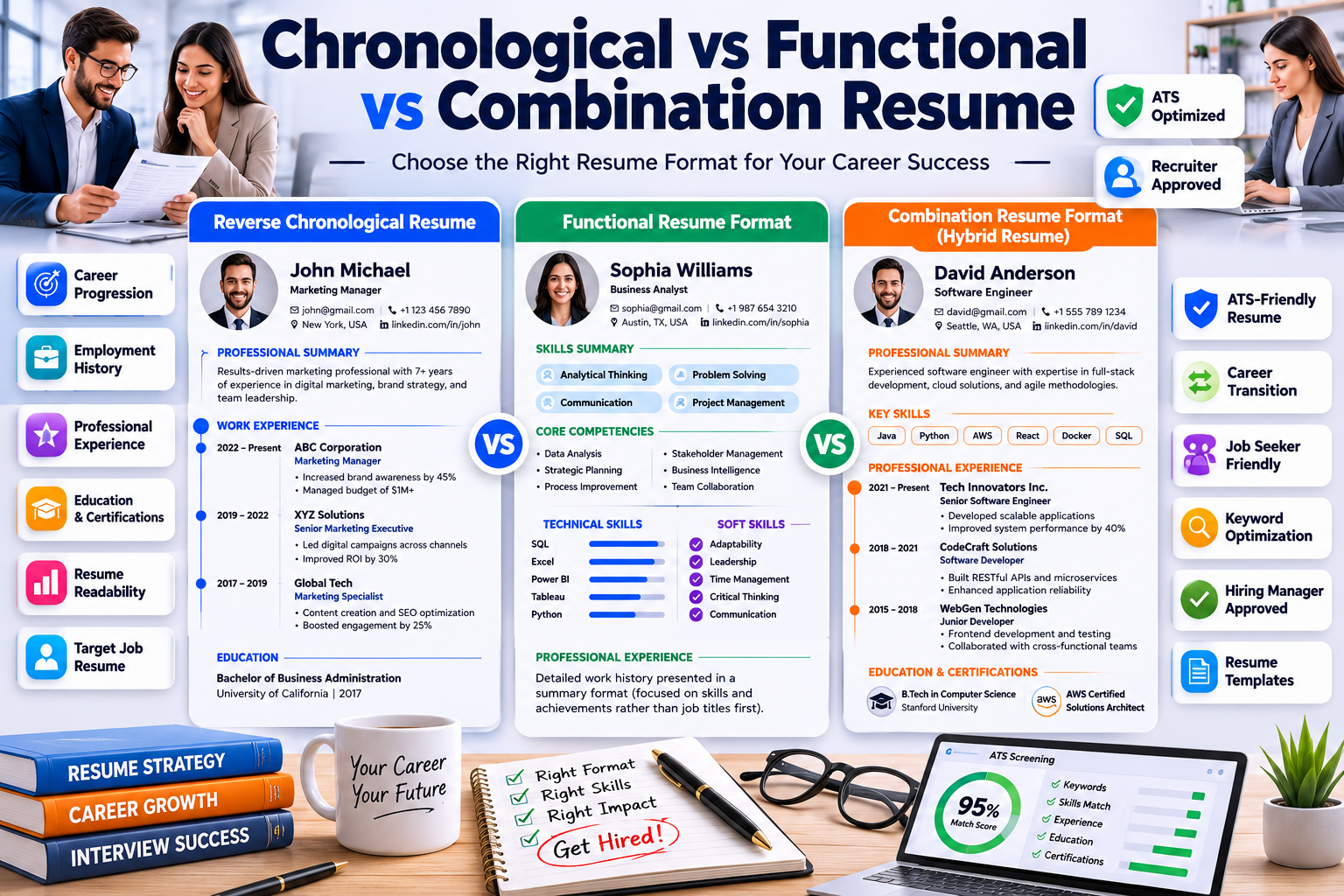
Choosing the right resume format can be the difference between landing an interview and having your application overlooked. Whether you’re a recent graduate, an experienced professional, or someone planning a career transition, your resume should present your qualifications in a way that appeals to both recruiters and modern hiring systems.
Many job seekers spend hours perfecting their content but overlook one critical factor—the resume format itself. Should you use a Reverse Chronological Resume, a Functional Resume Format, or a Combination Resume Format? Each has its strengths, limitations, and ideal use cases.
Today’s employers don’t just rely on human reviewers. Most organizations use an Applicant Tracking System (ATS) to scan resumes before they ever reach a recruiter. That means your document must be an ATS-Friendly Resume with clear Resume Structure, logical Resume Sections, proper Resume Formatting, and strategically placed keywords that align with the target role.
In this comprehensive guide, we’ll compare the three most popular resume formats, explain when each works best, and help you choose the right approach based on your experience, career goals, and industry. You’ll also learn how Recruiter Preference, ATS Optimization, and Resume Readability influence hiring decisions.
What Is a Resume Format?
A resume format is the overall organization of your professional information. It determines where employers see your Professional Summary, Work Experience Section, Key Skills Section, Education Section, Certifications, and other essential details.
Think of it as the blueprint of your resume. The same qualifications can appear much stronger—or much weaker—depending on how they’re presented.
A well-designed format helps recruiters quickly identify:
- Your Professional Experience
- Your Career Progression
- Your Relevant Experience
- Your technical and interpersonal abilities
- Your accomplishments
- Your educational background
Selecting the right format improves both human readability and machine parsing, making your resume more effective from the first glance.
The Three Main Resume Formats
Nearly every professional resume falls into one of three categories:
- Chronological Resume Format
- Functional Resume Format
- Combination Resume Format (also known as a Hybrid Resume)
Each emphasizes different aspects of your background.
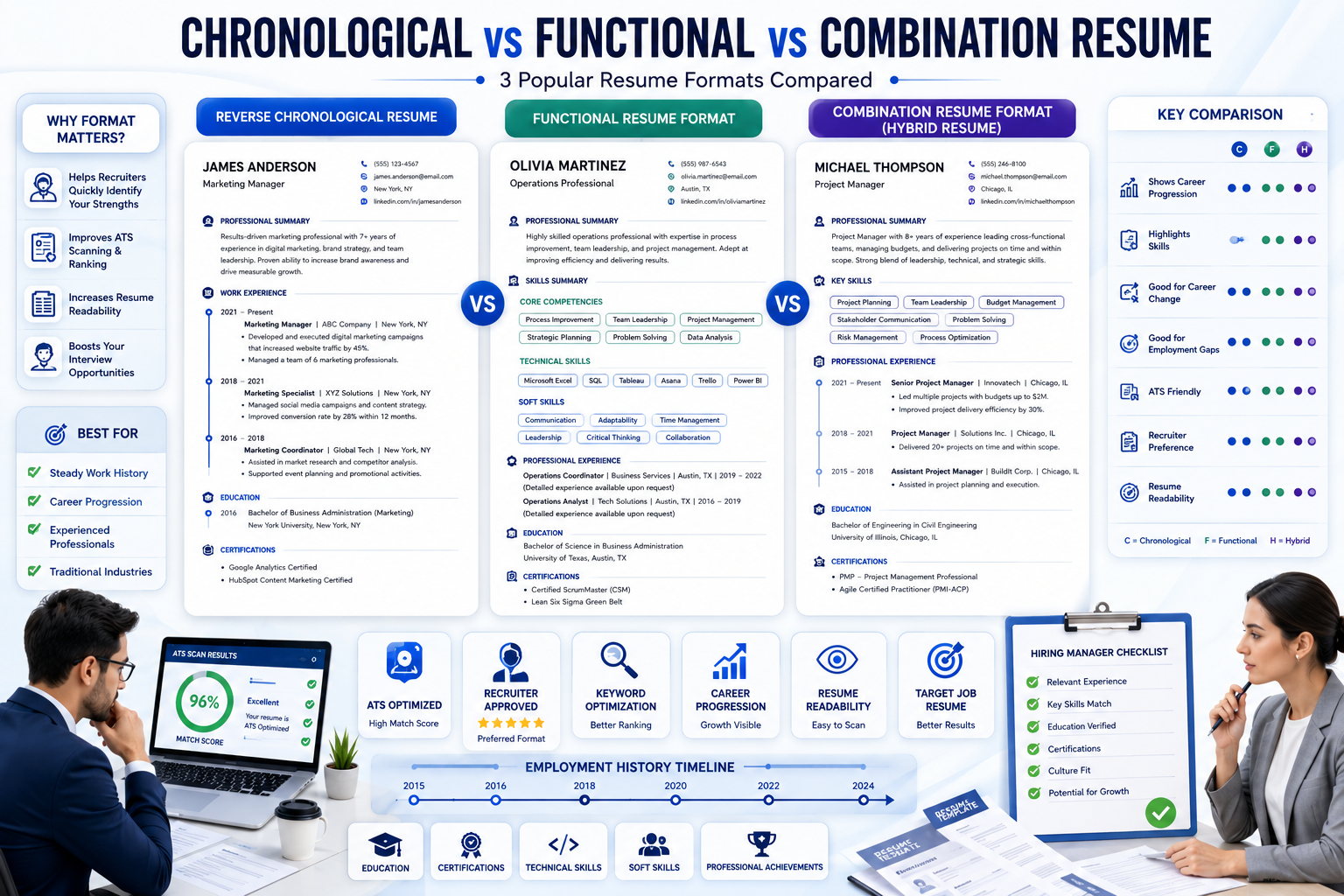
| Resume Format | Best For | Focus |
|---|---|---|
| Chronological Resume | Professionals with steady work history | Employment History |
| Functional Resume | Career changers, employment gaps | Skills & abilities |
| Combination Resume | Experienced professionals with strong skills | Skills + Experience |
Understanding these differences is the first step toward building a Target Job Resume that matches employer expectations.
Understanding the Reverse Chronological Resume
The Reverse Chronological Resume, often referred to simply as the Chronological Resume Format, is the most widely used and recruiter-friendly resume style.
Instead of listing your first job first, it presents your work history in Reverse Chronological Order, beginning with your most recent position and working backward through your Employment Timeline.
Because employers want to know what you’ve done recently, this format naturally aligns with how recruiters review candidates.
Typical Structure
A standard Chronological Resume Format includes:
- Contact Information
- Professional Summary
- Professional Experience
- Education Section
- Certifications
- Technical Skills
- Additional Information
This layout clearly demonstrates your Career Timeline and makes your Career Progression easy to follow.
Example Layout
Professional Summary
Results-driven marketing specialist with five years of experience leading digital campaigns, improving customer engagement, and increasing revenue through data-driven strategies.
Professional Experience
Marketing Specialist
ABC Company
- Increased website traffic by 45%
- Improved conversion rate by 27%
- Managed $500,000 annual advertising budget
- Led cross-functional marketing initiatives
Marketing Executive
XYZ Company
- Coordinated social media campaigns
- Developed email marketing strategies
- Improved customer retention
Notice how recruiters can immediately understand the applicant’s progression.
Why Recruiters Love Chronological Resumes
One reason this format remains the industry standard is Recruiter Preference.
Hiring managers often spend only a few seconds reviewing an application before deciding whether to continue reading. A clear Work Experience Section allows them to quickly evaluate:
- Career growth
- Promotions
- Job stability
- Industry expertise
- Leadership experience
When your resume tells a logical story, recruiters spend less time searching for key information and more time appreciating your qualifications.
ATS Compatibility
Most employers rely on an Applicant Tracking System (ATS) to filter resumes before a recruiter ever sees them.
A well-organized ATS-Friendly Resume typically performs better because ATS software can easily identify standard headings such as:
- Professional Summary
- Work Experience
- Education Section
- Key Skills Section
- Certifications
Avoiding unusual graphics, tables, or non-standard layouts improves ATS Optimization and ensures your qualifications are parsed correctly.
Advantages of the Chronological Resume Format
The Chronological Resume Format offers several important benefits:
Clearly Shows Career Progression
Employers can easily understand how you’ve advanced over time.
Promotions, increased responsibilities, and leadership roles become immediately visible.
Demonstrates Stable Employment History
Companies often value consistent employment.
A chronological layout highlights a stable Employment History, making it easier for recruiters to trust your professional journey.
Emphasizes Professional Achievements
Each position provides an opportunity to showcase measurable Professional Achievements.
Rather than simply listing duties, use Accomplishment Statements such as:
- Increased annual sales by 35%
- Reduced operational costs by 20%
- Led a team of 15 employees
- Improved customer satisfaction ratings
These quantified results make your experience more compelling.
Easy for Hiring Managers to Review
Recruiters appreciate resumes that require little effort to understand.
A logical Resume Layout improves Resume Readability, increasing the chances that your accomplishments receive the attention they deserve.
When Should You Use a Reverse Chronological Resume?
This format is ideal if you:
- Have consistent work experience
- Have several years of professional experience
- Have progressed within your industry
- Have few employment gaps
- Want to emphasize promotions
It’s especially suitable for:
- Corporate professionals
- Managers
- Engineers
- Accountants
- Marketing specialists
- Healthcare professionals
- IT professionals
- Finance experts
An Experienced Professional Resume almost always benefits from this structure.
Potential Drawbacks
Although highly effective, the chronological format isn’t perfect.
It may not be the best choice if you have:
- Significant Employment Gaps
- Frequent job changes
- Limited experience
- Multiple career changes
In these cases, another resume format may present your qualifications more effectively.
Understanding the Functional Resume Format
Unlike chronological resumes, the Functional Resume Format focuses primarily on skills rather than employment dates.
Also known as a Skills-Based Resume, this format organizes your experience according to abilities instead of employers.
Instead of emphasizing your Employment History, it highlights what you can do.
This approach is particularly useful when your skills matter more than your job titles.
Typical Functional Resume Structure
A functional resume generally includes:
- Contact Information
- Resume Objective or Professional Summary
- Skills Summary
- Core Competencies
- Key Skills Section
- Selected Work History
- Education Section
- Certifications
Notice that the emphasis shifts away from chronology and toward expertise.
What Goes into the Skills Summary?
The Skills Summary is the heart of a functional resume.
Instead of listing employers first, applicants organize experience into skill categories.
For example:
Project Management
- Led cross-functional teams
- Delivered projects before deadlines
- Reduced operational costs
- Improved workflow efficiency
Leadership
- Supervised 20 employees
- Conducted training programs
- Improved employee retention
Communication
- Presented to executive leadership
- Negotiated vendor contracts
- Managed client relationships
These categories allow candidates to demonstrate value even if their employment history isn’t perfectly linear.
Why Choose a Functional Resume?
The Functional Resume Format works particularly well for professionals who want to emphasize Transferable Skills.
Examples include:
- Military veterans entering civilian careers
- Teachers moving into corporate roles
- Freelancers
- Consultants
- Individuals returning to work
- Professionals pursuing a Career Transition
Instead of focusing on job titles, recruiters immediately see the candidate’s strongest capabilities.
Ideal for Career Changes
Suppose you’ve spent ten years in customer service but want to become a project manager.
Your previous job titles may not immediately communicate your readiness for the new role.
A Career Change Resume using a functional structure can emphasize:
- Leadership
- Organization
- Budget management
- Communication
- Team coordination
- Problem-solving
These Transferable Skills are often more relevant than your previous titles.
Helpful for Employment Gaps
Candidates with extended Employment Gaps frequently worry about how recruiters will perceive their resumes.
A functional format shifts attention toward achievements and capabilities rather than employment dates.
This doesn’t eliminate the need to be honest about your work history, but it allows your qualifications to take center stage.
Functional Resume Example
Professional Summary
Creative operations specialist with expertise in workflow optimization, leadership, customer success, and strategic planning.
Core Competencies
- Team Leadership
- Strategic Planning
- Customer Success
- Process Improvement
- Data Analysis
Skills Summary
Project Coordination
- Managed multiple simultaneous initiatives
- Improved productivity
- Reduced turnaround time
Leadership
- Mentored junior employees
- Built high-performing teams
- Implemented performance improvement programs
This structure immediately emphasizes expertise before employers review your work history.
Is a Functional Resume Always the Best Choice?
Not necessarily.
While it highlights strengths, some recruiters prefer to evaluate a candidate’s Employment History first. In addition, certain ATS platforms and hiring managers may expect a more traditional Chronological Resume Format, especially for roles where consistent career progression is important.
That’s why choosing the right format depends on your background, your target role, and the expectations of your industry.
Understanding the Combination Resume Format (Hybrid Resume)
The Combination Resume Format, often called a Hybrid Resume, blends the strengths of both the Reverse Chronological Resume and the Functional Resume Format. It highlights your most valuable skills while also providing a clear Employment History in Reverse Chronological Order.
This format has become increasingly popular because today’s employers want to see two things:
- What you can do (skills and accomplishments)
- Where you’ve applied those skills (professional experience)
Instead of forcing recruiters to choose between your abilities and your work history, a combination resume presents both in a balanced, easy-to-read layout.
Who Should Use a Combination Resume?
A Combination Resume Format is ideal for professionals who have developed a solid career history while also possessing specialized expertise.
It works particularly well for:
- Mid-level professionals
- Senior managers
- IT professionals
- Software developers
- Engineers
- Healthcare professionals
- Marketing specialists
- Sales professionals
- Project managers
- Consultants
It is also highly effective for professionals making a Career Transition who already possess significant Transferable Skills.
For example, a software engineer moving into product management can highlight leadership, communication, stakeholder management, and technical expertise before listing their employment history.
Standard Combination Resume Structure
A modern Hybrid Resume usually follows this order:
- Contact Information
- Professional Summary
- Key Skills Section
- Core Competencies
- Technical Skills
- Selected Professional Achievements
- Professional Experience
- Education Section
- Certifications
Because this structure starts with skills while still including a complete Work Experience Section, it satisfies both ATS software and human recruiters.
Example Combination Resume
Professional Summary
Experienced Digital Marketing Manager with eight years of experience driving revenue growth through SEO, PPC, content marketing, and analytics. Proven record of increasing organic traffic and leading cross-functional marketing teams.
Core Competencies
- Digital Marketing
- SEO Strategy
- PPC Advertising
- Data Analytics
- Team Leadership
- Budget Management
Professional Achievements
- Increased annual revenue by 42%
- Reduced advertising costs by 25%
- Managed marketing budgets exceeding $2 million
- Led a team of 18 marketing professionals
Professional Experience
Senior Marketing Manager
ABC Corporation
2022–Present
Marketing Manager
XYZ Technologies
2018–2022
Marketing Executive
Global Solutions
2015–2018
This format quickly demonstrates both capability and career growth.
Why Employers Like Hybrid Resumes
The Combination Resume Format provides a balanced view of a candidate.
Recruiters immediately see:
- Your strongest abilities
- Your measurable achievements
- Your employment timeline
- Career progression
- Relevant work history
Instead of searching through multiple pages, hiring managers can quickly determine whether your experience aligns with the role.
Resume Format Comparison
Choosing the right resume format depends on your career stage, experience level, and professional goals.
Here’s a practical comparison.
| Feature | Chronological Resume Format | Functional Resume Format | Combination Resume Format |
|---|---|---|---|
| Main Focus | Employment History | Skills | Skills + Experience |
| ATS Friendly | Excellent | Moderate | Excellent |
| Recruiter Preference | Very High | Moderate | High |
| Best For | Experienced professionals | Career changers | Skilled professionals |
| Shows Career Progression | Excellent | Limited | Excellent |
| Highlights Transferable Skills | Moderate | Excellent | Excellent |
| Good for Employment Gaps | No | Yes | Moderate |
| Easy to Read | Excellent | Good | Excellent |
| Resume Readability | High | High | Very High |
| Resume Customization | Easy | Moderate | Easy |
This Resume Format Comparison demonstrates that there is no universally perfect choice. The right format depends on your professional story.
Which Resume Format Is Best for Different Job Seekers?
Let’s examine common scenarios.
For Entry-Level Candidates
An Entry-Level Resume often contains limited professional experience.
If you’ve completed internships, freelance work, volunteer projects, or academic assignments, a Combination Resume Format usually works better than a purely functional resume.
Include:
- Academic projects
- Technical skills
- Internship experience
- Volunteer work
- Certifications
Employers understand that graduates may have limited work history, so demonstrating practical skills becomes especially important.
For Experienced Professionals
An Experienced Professional Resume should almost always emphasize career progression.
Recruiters expect to see:
- Promotions
- Leadership roles
- Increasing responsibilities
- Major accomplishments
- Professional growth
A Reverse Chronological Resume remains the strongest choice in most industries because it clearly demonstrates your Employment Timeline and long-term value.
For Career Changers
If you’re switching industries, employers may focus less on previous job titles and more on your capabilities.
For example:
A teacher becoming a corporate trainer.
A military officer entering operations management.
A customer service representative moving into HR.
A Career Change Resume should showcase Transferable Skills, including:
- Leadership
- Communication
- Project management
- Organization
- Problem-solving
- Team collaboration
A Hybrid Resume is often the ideal solution because it combines skills with relevant work experience.
For Professionals With Employment Gaps
Career breaks happen for many reasons:
- Higher education
- Family responsibilities
- Personal health
- Entrepreneurship
- Freelancing
If your resume contains noticeable Employment Gaps, avoid trying to hide them.
Instead:
- Highlight measurable achievements.
- Include freelance or consulting work.
- Showcase certifications earned during the gap.
- Add volunteer experience when relevant.
- Demonstrate continuous learning.
A Combination Resume Format often balances transparency with skill-focused storytelling.
ATS Optimization: Why Resume Format Matters
Today, many companies use an Applicant Tracking System (ATS) before a recruiter reviews your application.
ATS software scans resumes for:
- Keywords
- Job titles
- Skills
- Experience
- Education
- Certifications
If your resume isn’t ATS-compatible, it may never reach a human recruiter.
Tips for Creating an ATS-Friendly Resume
Use Standard Headings
Choose headings such as:
- Professional Summary
- Professional Experience
- Education
- Skills
- Certifications
Avoid creative titles that ATS software may not recognize.
Include Relevant Keywords
Practice smart Keyword Optimization by matching the language used in the job description.
For example:
If the employer requests:
- SQL
- Data Analysis
- Project Management
Include those exact terms naturally within your resume when they genuinely reflect your experience.
Avoid Complex Graphics
Many ATS systems struggle with:
- Text boxes
- Icons
- Charts
- Multiple columns
- Images
- Decorative elements
Simple formatting improves parsing accuracy.
Keep Formatting Clean
Good Resume Formatting includes:
- Consistent fonts
- Standard bullet points
- Logical spacing
- Clear section headings
Clean formatting also improves Resume Readability for recruiters.
What Recruiters Look for During Recruiter Screening
Recruiters usually spend only a short amount of time reviewing a resume before deciding whether to continue.
During Recruiter Screening, they typically look for:
- Relevant experience
- Career stability
- Promotions
- Professional achievements
- Technical expertise
- Industry-specific keywords
- Education
- Certifications
The easier your resume is to scan, the more likely recruiters are to continue reading.
Importance of a Strong Professional Summary
Your Professional Summary is one of the first sections recruiters read.
Instead of vague statements, focus on measurable value.
Poor example:
Hardworking professional seeking new opportunities.
Better example:
Results-driven Software Engineer with seven years of experience developing scalable cloud applications. Reduced deployment time by 45%, improved application performance, and led Agile development teams across multiple enterprise projects.
Specific achievements immediately increase credibility.
Resume Objective vs Professional Summary
Many applicants wonder whether they should use a Resume Objective or a Professional Summary.
Resume Objective
Best for:
- Students
- Graduates
- Career changers
- Professionals re-entering the workforce
It explains what you’re seeking and how your skills align with the role.
Example:
Motivated business graduate seeking an entry-level financial analyst role where strong analytical and communication skills can contribute to data-driven decision-making.
Professional Summary
Best for experienced professionals.
It emphasizes accomplishments rather than career goals.
Example:
Financial Analyst with eight years of experience improving forecasting accuracy, reducing operational costs, and supporting executive decision-making through advanced financial modeling.
Building an Effective Skills Section
Every modern resume should include a well-organized Key Skills Section.
Instead of listing dozens of unrelated abilities, prioritize those most relevant to the target role.
Example:
Technical Skills
- Python
- SQL
- Tableau
- Power BI
- AWS
- Docker
Soft Skills
- Leadership
- Communication
- Problem-solving
- Adaptability
- Time management
- Collaboration
Including both Technical Skills and Soft Skills provides a more complete picture of your capabilities.
Demonstrating Core Competencies
Your Core Competencies should reflect the strengths that define your professional value.
Examples include:
- Strategic Planning
- Data Analysis
- Budget Management
- Business Development
- Risk Assessment
- Customer Relationship Management
- Agile Project Management
- Product Strategy
Select competencies that align with the position you’re applying for rather than using generic buzzwords.
Showcasing Professional Achievements
One of the biggest differences between an average resume and an outstanding one is the use of measurable Professional Achievements.
Instead of listing responsibilities, include Accomplishment Statements that quantify your impact.
Compare these examples:
Weak
- Managed a sales team.
Strong
- Led a 12-member sales team that exceeded annual revenue targets by 28%.
Weak
- Improved customer service.
Strong
- Increased customer satisfaction scores from 82% to 96% within one year through process improvements and employee training.
Numbers make your achievements more credible and memorable.
Common Resume Mistakes That Can Cost You Interviews
Even highly qualified professionals sometimes miss interview opportunities because of avoidable resume mistakes. Recruiters and hiring managers often review hundreds of applications for a single role, so even minor issues can reduce your chances of moving forward.
Whether you’re creating a Reverse Chronological Resume, Functional Resume Format, or Combination Resume Format, avoiding these mistakes can significantly improve your success rate.
1. Choosing the Wrong Resume Format
One of the biggest mistakes is selecting a format that doesn’t support your career story.
For example:
- A professional with 10 years of stable experience using a Functional Resume Format may unintentionally hide valuable career progression.
- A recent graduate using a traditional chronological format with little experience might struggle to demonstrate their strengths.
Always choose the format that best highlights your qualifications.
2. Writing a Generic Resume
Many applicants send the same resume to every employer.
Hiring managers immediately notice generic applications.
Instead, focus on Resume Customization by tailoring your resume for each position.
Review the job description carefully and adjust:
- Skills
- Keywords
- Professional Summary
- Professional Achievements
- Technical Skills
A customized Target Job Resume performs much better during both recruiter review and ATS screening.
3. Ignoring Keyword Optimization
Today’s employers often rely on ATS software to filter resumes before a recruiter reviews them.
Without proper Keyword Optimization, even highly qualified candidates can be rejected automatically.
For example, if a job description repeatedly mentions:
- Project Management
- SQL
- Power BI
- Customer Success
- Agile
Those keywords should naturally appear throughout your resume if they accurately reflect your experience.
Avoid keyword stuffing—use relevant terms only where appropriate.
4. Listing Responsibilities Instead of Results
Recruiters are less interested in what you were supposed to do and more interested in what you actually accomplished.
Instead of writing:
- Responsible for managing social media.
Write:
- Increased social media engagement by 62% through content optimization and audience targeting.
Whenever possible, include measurable Professional Achievements using numbers, percentages, or specific outcomes.
5. Poor Resume Formatting
Even excellent content can be overlooked if the document is difficult to read.
Good Resume Formatting includes:
- Consistent fonts
- Clear headings
- Proper spacing
- Uniform bullet points
- Logical section order
A clean Resume Layout improves both recruiter experience and Resume Readability.
6. Overloading the Resume With Information
Your resume should highlight your most relevant qualifications rather than every job you’ve ever held.
Focus on:
- Relevant Experience
- Professional Experience
- Skills
- Certifications
- Major accomplishments
Remove outdated or unrelated information that doesn’t support your target role.
Resume Formatting Best Practices
A professional resume should be easy to scan within a few seconds.
Here are some best practices that work across industries.
Use Clear Resume Sections
Organize your information using standard headings such as:
- Contact Information
- Professional Summary
- Professional Experience
- Work Experience Section
- Key Skills Section
- Education Section
- Certifications
These familiar Resume Sections help both recruiters and ATS software navigate your document.
Keep Your Resume Structure Logical
A strong Resume Structure generally follows this order:
- Contact Information
- Professional Summary or Resume Objective
- Skills
- Professional Experience
- Education
- Certifications
- Additional Information (if applicable)
Avoid jumping between unrelated sections.
Choose a Professional Resume Layout
Your Resume Layout should emphasize readability over creativity.
Use:
- One-inch margins
- Readable fonts (Calibri, Arial, Helvetica, or Georgia)
- Font size between 10–12 points for body text
- Bold headings
- Consistent spacing
Avoid excessive colors, decorative graphics, and unusual fonts unless you’re applying for a design-focused role.
Select the Right Resume Template
A professionally designed Resume Template saves time while maintaining a polished appearance.
Look for templates that are:
- ATS-friendly
- Clean and minimal
- Easy to edit
- Professionally structured
- Compatible with PDF and Word formats
Avoid templates with multiple columns, heavy graphics, or complex design elements that may confuse ATS software.
How to Customize Your Resume for Every Job
One-size-fits-all resumes rarely perform well in today’s competitive job market.
Effective Resume Customization involves aligning your resume with the employer’s specific requirements.
Step 1: Analyze the Job Description
Identify recurring:
- Job Titles
- Technical Skills
- Soft Skills
- Industry terminology
- Responsibilities
These often indicate what the employer values most.
Step 2: Update Your Professional Summary
Highlight experience that directly matches the role.
Example:
If applying for a project management position, emphasize leadership, planning, budgeting, and stakeholder communication rather than unrelated achievements.
Step 3: Prioritize Relevant Experience
Reorder bullet points so that the most relevant accomplishments appear first under each role.
Recruiters often read only the first few bullets.
Step 4: Match Skills to the Position
Include only the Technical Skills, Soft Skills, and Core Competencies that genuinely align with the job description.
This improves relevance while keeping the resume focused.
Choosing the Best Resume Format: Quick Recommendations
If you’re still unsure which resume format to use, the following guidelines can help.
Choose a Reverse Chronological Resume if:
- You have a stable employment history.
- You want to highlight career progression.
- You’re applying for corporate or traditional roles.
- You have several years of relevant experience.
Choose a Functional Resume Format if:
- You’re changing careers.
- You have significant employment gaps.
- Your transferable skills are more important than your job titles.
- You have limited direct experience in the target field.
Choose a Combination Resume Format if:
- You have valuable technical expertise.
- You want to showcase both skills and work history.
- You have measurable achievements.
- You’re applying for senior or specialized positions.
For many professionals, the Hybrid Resume offers the best balance between showcasing skills and demonstrating a solid employment history.
FAQ
Which resume format do recruiters prefer?
Most recruiters favor the Reverse Chronological Resume because it clearly presents your Employment History, Career Progression, and recent Professional Experience. However, a Combination Resume Format is also highly regarded for candidates with specialized skills and measurable achievements.
Which resume format is best for ATS?
A clean ATS-Friendly Resume with standard headings, simple formatting, and relevant keywords generally performs best. Both chronological and combination resumes work well with modern ATS platforms when they use a clear structure.
Is a functional resume bad?
Not at all. A Functional Resume Format can be an excellent choice for professionals making a Career Transition, those with Employment Gaps, or candidates whose Transferable Skills are more relevant than their work history. However, some recruiters prefer to see a detailed employment timeline, so consider your industry and target role.
How long should a resume be?
- Entry-Level Resume: One page is usually sufficient.
- Experienced Professional Resume: One to two pages is generally appropriate, depending on the depth of your experience and accomplishments.
Focus on relevance rather than length.
Should I include certifications?
Yes. Include Certifications that strengthen your qualifications for the target position. Industry-recognized credentials can help demonstrate expertise and continuous learning.
What’s the difference between a Resume Objective and a Professional Summary?
A Resume Objective explains your career goals and is often best for students, graduates, or career changers. A Professional Summary highlights your experience, achievements, and value to employers, making it more suitable for experienced professionals.
Final Thoughts
There isn’t a single resume format that’s perfect for everyone. The best choice depends on your experience, career goals, and the role you’re pursuing.
If you have a strong and consistent work history, a Chronological Resume Format remains the gold standard. It clearly showcases your Employment Timeline, Career Progression, and professional growth, making it a favorite among recruiters and hiring managers.
If you’re changing careers or have significant employment gaps, a Functional Resume Format can draw attention to your Transferable Skills, Core Competencies, and accomplishments rather than focusing solely on dates and job titles.
For professionals who want to balance technical expertise with a solid work history, the Combination Resume Format, also known as a Hybrid Resume, offers the best of both worlds. It highlights your skills while preserving a clear employment record, making it a strong option for many mid-level and senior candidates.
Regardless of the format you choose, keep these principles in mind:
- Build an ATS-Friendly Resume with standard headings and clean formatting.
- Use Keyword Optimization naturally by reflecting the language of the job description.
- Showcase measurable Professional Achievements with clear, results-focused Accomplishment Statements.
- Include relevant Technical Skills, Soft Skills, Certifications, and Professional Experience.
- Prioritize Resume Readability through a clean Resume Layout and logical Resume Structure.
- Tailor every application with thoughtful Resume Customization to create a compelling Target Job Resume.
A well-crafted resume is more than a summary of your background—it’s a strategic marketing document that tells your professional story. By selecting the right format and presenting your qualifications clearly, you’ll improve your chances of passing ATS screening, capturing recruiter attention, and securing more interviews.